Off this coast lives the loneliest group of humpback whales on Earth. Maybe a hundred of them. They don't migrate. Genetics says they have been cut off from every other humpback for tens of thousands of years.
Everywhere else, male humpbacks share one song per population, and that song keeps changing. Off Hawaii or Australia, it can be replaced almost completely within two or three years.
In 2018 a team who had dropped recorders off Hallaniyat and Duqm reported something nobody had seen before: the Oman song from 2011 to 2013 was virtually unchanged. They called it stasis. Even when southern whales sang their own song in Omani water one August, the locals didn't pick any of it up.
They said it deserved a proper follow-up. I couldn't find one.
In December 2019 a recorder off Netrani Island, India, caught one singer from the same population. That paper (2023) didn't compare it to Oman, because humpback song changes too fast for comparisons across years to mean much. Which is the exact thing the Oman team said might not be true here.
So I put them side by side. I wrote my bet down first: if the song really stands still, a few of the 2019 phrases should look like the 2013 ones.
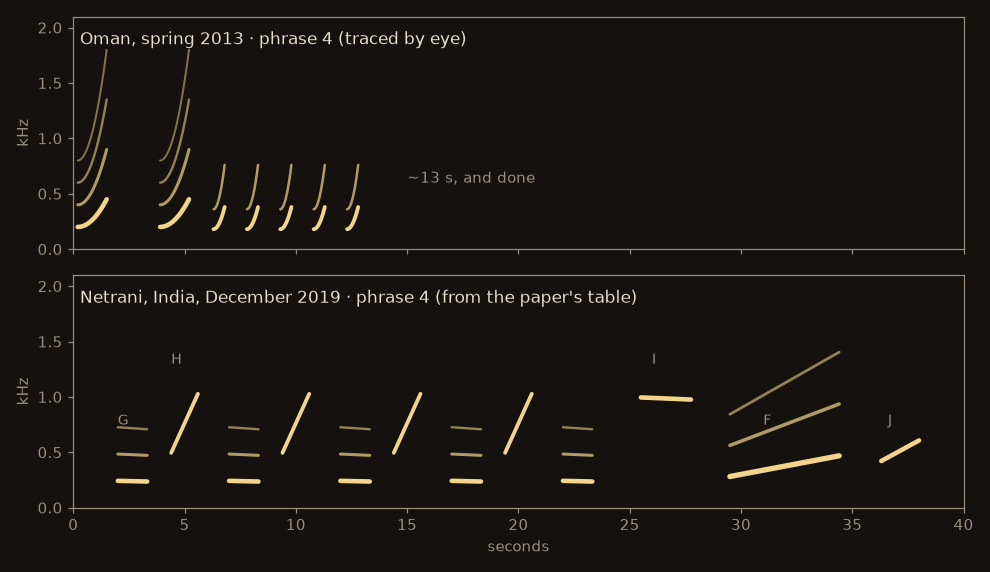
A sketch, not a recording. The bottom half is drawn from the 2019 paper's measured table. The top half I traced by eye.
I couldn't find a single shared phrase. The 2019 singer uses long held tones, five seconds each, hundreds of times. Nothing in the 2013 song holds a note that long.
I'm not a bioacoustician, and my eye was the instrument. It was one whale, passing through, for four days. In 2011 the experts did match song from India to Oman, so the two coasts once shared it.
So it's three possibilities, and I can't choose between them. The stillness was a three-year window, and the song has since moved on, just slowly. Or that whale wasn't singing the local song. Or the match is there and I can't see it.
What would settle it is the same recorders, same coast, a decade on. If anyone has them, I'd like to know.
26 November 2026
The paper's own guess for the stillness: fewer males, so fewer new ideas. I tried it in a toy. Males copy each phrase from one another, season after season, and now and then one invents a new version.
If they copy at random, size hardly matters. Forty males and four hundred change at about the same pace, within a factor of two or three. For forty to stand still while four hundred churn, they have to prefer the newest version. Then it works: forty nearly frozen, four hundred changing like Hawaii, seven times faster.
But in August 2012 southern males sang a brand-new song off Oman for 25 days, and the local males took none of it. A population that loves novelty shouldn't do that. So "few males" explains one observation and fights the other. The paper's other guess, that these whales have partly lost the habit of picking up new song, explains both with one cause. Unless they only learn in their own season, which the toy can't tell apart. It's a toy.
Then the birds. On Kent Island, Canada, a study plot of Savannah sparrows, about forty to fifty pairs, was recorded for thirty years. That is roughly the same headcount as the Arabian Sea's grown males. The opening notes and the buzz never changed. The middle of the song got a new favourite version nearly every year. The final trill drifted steadily, because females rewarded it. So forty singers is enough to change a song. The speed belongs to each part of the song, not to the headcount. Which makes the whales stranger, not less strange.