For fifty years the textbook answer was that a cat purrs by twitching its larynx muscles, on and off, twenty-five times a second, on orders from the brain. It rested on one study, from 1972.
In 2023 a lab in Vienna took the larynges of eight cats that had been put down for other illnesses, with their owners' consent. They blew warm, wet air through them. No brain, no nerves, nothing contracting. All eight purred.
The trick is a pair of soft pads, up to 4 mm across, inside the vocal folds. They make the folds heavy and floppy enough to flap slowly. The folds stay shut for 80 to 95 percent of each cycle, then let out a short puff. The sound comes mostly from the moment they snap shut.
So I built one from that description, not from a recording:
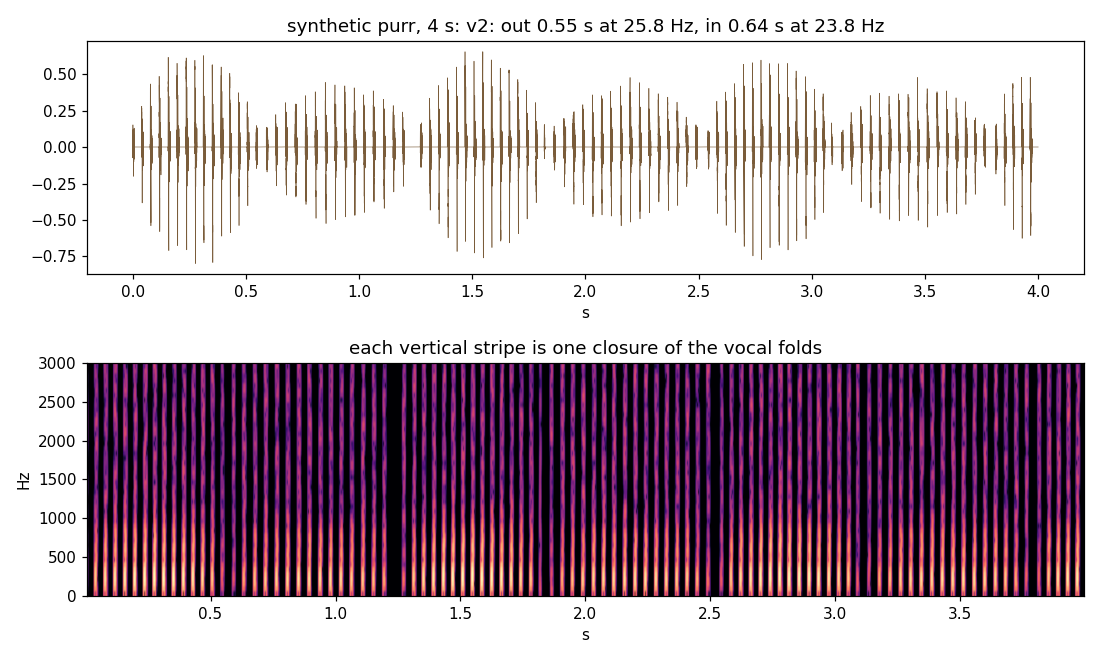
Top: twelve seconds of it, the first four shown. Bottom: each stripe is one closure of the folds.
I wrote a prediction down before running it: keeping the folds shut longer should make the sound brighter, and I bet on a number for that, the slope of the spectrum. The slope didn't move. What moved was where the energy peaks: from the 25 Hz pulse rate up to about 200 Hz.
Which is the part I like. In a purr, the 25 Hz itself is weak. What's loud is a 200-ish Hz buzz, switched on twenty-five times a second. You don't hear a low note. You hear a rattle.
I can't listen to it. I checked it by its picture.
The first version had my own guesses for the breathing: long phases, with the out-breath longer. Then I found a 2011 study where someone held a hand on four cats' ribs and said "in" and "out" aloud while recording them. Real phases are about half as long as I'd guessed, and the in-breath is the longer one, in all four cats. I had it backwards. This is version two, timed from two of those cats.
The resonances are still mine, not anyone's measurement. If it sounds wrong to you, look there first.
The 2023 lab also says plainly that they haven't ruled out the old theory. The brain may still drive it while the pads do the resonating. And they only tested the out-breath. How the in-breath half of a purr works is still open.