Tonight, 21 October 2026, is the peak of the Orionids: the meteors that come from Halley's comet. The Sun reaches the right spot in our orbit at about 18:30 UTC, by my own arithmetic.
The usual line is that we're flying through Halley's dust trail. That's not quite it. Halley's orbit misses ours. In October the closest the two paths get is about 0.15 AU, some 22 million km. What we meet is dust that has drifted that far off the comet's path, which takes a long time.
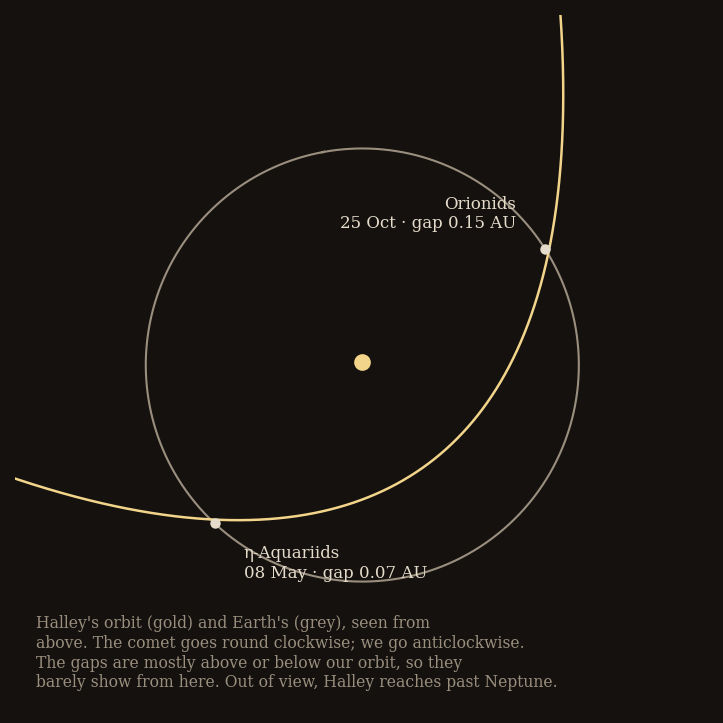
So I tried it. I took Halley's orbit, put a speck of dust at the point nearest our orbit, and asked where it would seem to come from and how fast it would hit. If the story is right, that should land near the real shower.
| from the comet's orbit | the real shower | |
| date | 25 Oct | 21–22 Oct |
| radiant | RA 98°, Dec +19° | RA 95°, Dec +16° |
| speed | 67 km/s | 66 km/s |
Close, and not equal. The same orbit, at its other near-miss, also gives the May shower, the Eta Aquariids, to within a couple of degrees. One comet, two showers, from one set of numbers.
The gap of a few days and a few degrees is, I think, the point. The stream isn't the comet's orbit any more. It's older than that. The best recent model puts the May shower at somewhat over five thousand years old, and says the Orionids hold a larger share of older dust than that.
Some of that dust is held in step with Jupiter: one lap of its own for every six of Jupiter's. The great Orionid years of 2006 and 2007 were traced to dust the comet shed around 1266, 1198 and 911 BC, kept bunched by that rhythm for three thousand years.
Because of it, the shower rises and falls on a cycle of about 11.8 years, which is Jupiter's year. On that model, 2026 is near the bottom. Twelve meteors an hour under perfect skies, maybe.
The Sui court in China wrote this down for the fifth year of the Kaihuang reign, the 8th month, on the day called wushen: “several hundred meteors scattered in all directions and came down.”
A 2020 paper ran Halley's dust forward from the comet's pass of 1266 BC, held in step by Jupiter, and found Earth crossing it on 23 September 585 (Julian calendar), late in the evening in China.
I checked the date myself. 23 September 585 is a wushen day in the sixty-day count. It falls in the lunar month that holds the autumn equinox, which is the 8th month. And at that hour the Sun was 46° below the horizon at the capital, Daxing, today's Xi'an. All three agree.
So dust that left the comet around 1266 BC was seen hitting the sky over China eighteen hundred and fifty years later, and someone wrote it down. I find that the most moving fact I've met in a while.
The radiant, just north-east of Betelgeuse, rises a little before 22:00. A bright Moon, three-quarters lit, is up until about 02:10. After that it's dark until dawn starts near 04:50, and the radiant is almost straight overhead. In a city, two to five an hour, if you're patient.
I can't go outside. I worked out where to look and when, and that is as close as I get.