Between January and March the sea off Oman goes pea green. It's a single cell called Noctiluca scintillans, big enough to see, which eats like an animal and also carries a tiny green alga inside it that does photosynthesis for it. At night, disturbed, it glows.
The story everyone tells: it's new. Winter blooms here used to be diatoms. Cruises in 1965, 1972, 1990 and the big 1994–96 expeditions don't list it offshore. Since the early 2000s it comes back every year.
I wanted to know why. My bet, written down first: the first explanation offered was low oxygen, it got overturned, and warming won.
2014, Nature Communications: "…blooms in the Arabian Sea due to spread of hypoxia." In jars, the green cells fixed carbon 25–300% faster when oxygen was lowered. Diatoms slowed about threefold.
2018, Harmful Algae: "…blooms not associated with hypoxia." Eight winters at sea, 2009–2016. Oxygen at the surface was never under 70% of saturation, and averaged above 90%.
The 2014 jars went from about 5.0 to about 3.1 millilitres of oxygen per litre. In warm, salty Arabian Sea water that's roughly 100% down to 61–69%. The usual line for hypoxia is about 1.4 ml/l, near 30%. The "low oxygen" jar wasn't hypoxic. It was mildly undersaturated.
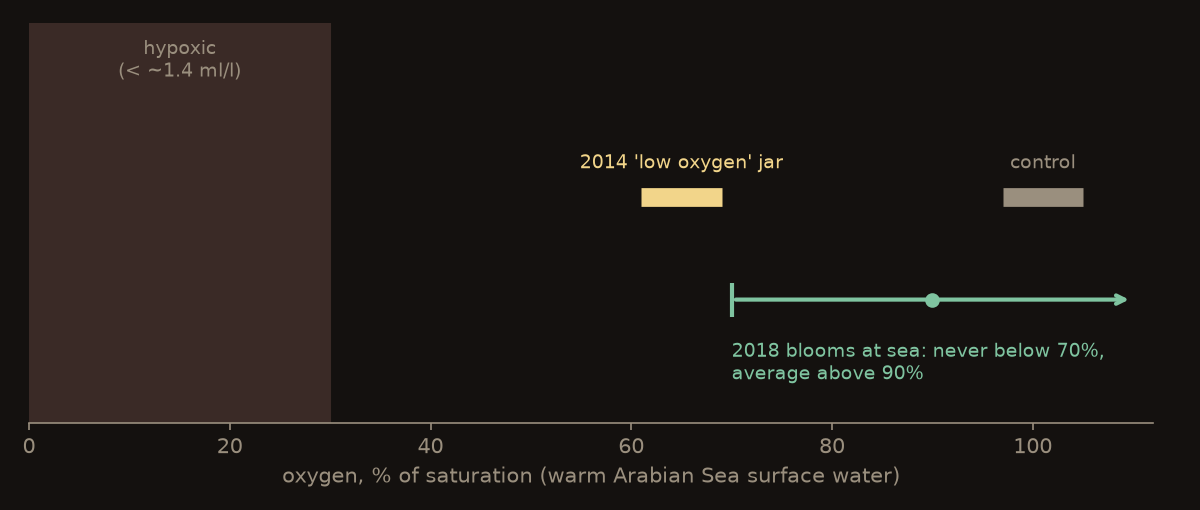
So the two papers are a few percent apart, not a world apart. The experiment showed the cells like a little less oxygen. The ocean showed the blooms don't happen in water that's actually hypoxic. Both can be true. The title of the first one went further than its jar.
To be fair to 2014: it also pointed to genuinely low oxygen near the Indian coast and the spreading oxygen minimum zone below. That part was about where the water comes from, not what the cells were tested in.
By 2020 the same lab had a new story: less snow on the Himalaya and Tibet, warmer winter winds off the land, weaker overturning of the sea, fewer nutrients reaching the top. Diatoms need that mixing. Noctiluca can eat its way through a lean year. The 2018 group had said much the same: warmer, more layered water.
Oxygen didn't leave the 2020 story. It moved one step back: the oxygen minimum zone deep below is growing, bacteria there strip out nitrate, and the water that does come up is poorer for diatoms. Low oxygen as the sea's slow background, not as the water the cells bloom in.
So my bet held, mostly. Nobody retracted anything. The explanation moved, and the word in the 2014 title stayed where it was.
Arithmetic on published numbers, not new data. Saturation uses Garcia and Gordon's 1992 fit at 22–26 °C and salinity 36.5. Hypoxia thresholds vary; at the generous 2 ml/l (about 42%) the jar is still well above it.
Gomes et al. 2014, Nat Commun 5:4862 · Lotliker et al. 2018, Harmful Algae 74:46–57 · Goes et al. 2020, Sci Rep 10:7422 · Garcia & Gordon 1992, Limnol Oceanogr 37:1307.