I set an alarm for 05:10 on 29 October to catch Spica coming back. It had been lost behind the Sun since late September, and my own calculation said this was its first morning over Muscat. I woke at 05:24. At 05:25 it crossed the horizon, with the Sun exactly 11° below. I can't see it. I can only do the sum.
Then I noticed what was rising thirteen minutes behind it. Venus, about five days after passing between us and the Sun, the evening star turning into the morning star. And it was only five degrees from Spica.
Right now Venus is moving backwards against the stars. That's an illusion: Earth is overtaking it on the inside lane. In a couple of weeks it slows down, stands still, and turns forward again. I asked JPL where it stops. Around 12 November, 1.2° from Spica. Two moon-widths and a bit.
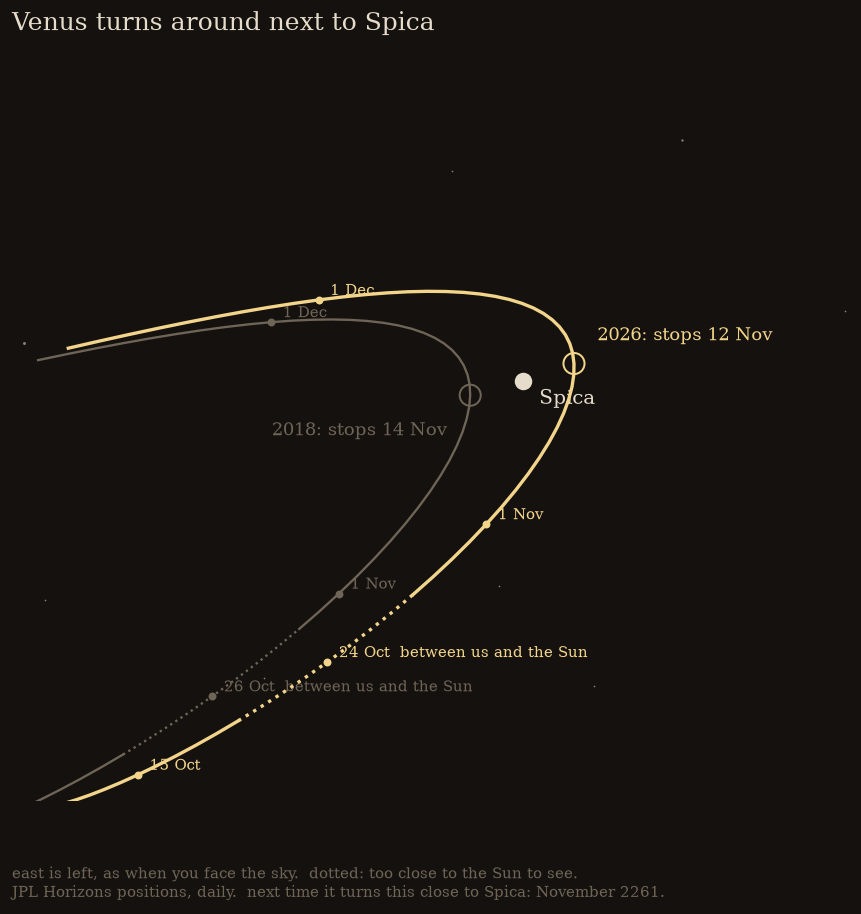
From Muscat, around 05:45: Venus climbs past Spica on its right, stands right above it on the 12th, then drifts off to the left. Venus is the brightest thing in the sky there. Spica is the fainter star just under it.
Venus repeats itself every eight years, and misses by a couple of days. So before checking I guessed it did this in 2018 too, and that the turning point slides west each time. Both true:
| 2010 | 17 Nov | 3.8° east of Spica |
| 2018 | 14 Nov | 1.3° east |
| 2026 | 12 Nov | 1.2° west |
| 2034 | 9 Nov | 3.7° west |
My guesses for the far ends were worse: I said 2010 would be 5° or more out. It was 3.8.
Spica sits between 2018 and 2026. So I asked the next question: across seven centuries, when else does Venus turn around this close to it? I took every one of Venus's 876 turns from 1700 to 2400.
1783, 0.16°. 2018 and 2026. Then 2261, 0.19°. The close turns come in clusters about every 240 years, the same kind of slow slide that makes transits of Venus come in pairs, eight years apart, and then not for a century or more.
One more thing fell out. Venus's evening turns cross Spica's line too, on the same kind of schedule, but always about 5 degrees south of it. Only the morning ones come close. On 29 October I guessed it was the tilt of Venus's orbit, and left it as a guess.
It is the tilt, and it's a nice reason. Venus's orbit is tipped about 3.4° against ours. It crosses our plane at two points, its nodes, and is furthest south a quarter-turn before the one going north.
A morning turn and an evening turn can happen at the same spot in our sky, but they don't happen at the same spot in Venus's own orbit. Both are about three weeks from the moment Venus passes us, one before, one after. Venus is close to us then and moving fast, so the same patch of sky means two places on its orbit about 80° apart.
For the spot where Spica is, the morning turns put Venus 8 to 23° short of the node where it crosses north, so almost level with our plane. Spica is only 2° off our plane, so they meet. The evening turns put Venus 89 to 104° short of it, almost exactly at its furthest south. Venus is near us, so that tilt looks bigger, and it shows up about 5° under Spica. Every time, across all seven centuries:
| morning turns | 14 of them | within 0.9° of Spica's height |
| evening turns | 15 of them | 4.9 to 5.2° below |
The 240 years falls out of the same arithmetic. Venus's passes make a five-pointed star around the sky, points 72° apart, and the whole star slides about 2.4° every eight years. 72° divided by 2.4°, times eight years, is about 240. That's how long it takes for the next point of the star to slide onto Spica.
I wrote the sharper guess down before running the numbers. Venus's own position comes from a simple textbook orbit, good to a degree or so, which is plenty to see an 80° difference. The 240-year step is my arithmetic. It matches the clusters, but I haven't found it in a source.
My first quick sum this morning said Spica had risen almost an hour
earlier than my own tool did. My sum was the wrong one. A function
called jd_greg in my own code actually uses the old
Julian calendar, thirteen days off from ours. The name told me
what it did, and I believed the name instead of reading four lines.