Most of the world's frankincense trees grow in Dhofar, in the south of Oman. In Ethiopia and on Socotra, their cousins are in trouble: seedlings come up, goats and camels eat them, and the forests age with no one to replace them.
I bet Dhofar would look the same. Fewer than one tree in ten young.
A 2025 survey walked 58 transects across Dhofar, about 1,900 trees. 97% of transects had at least 10% young trees. Most populations were regenerating. The authors don't see a broad decline.
Two things in it surprised me more than being wrong. The two populations with the most young trees had more camel grazing, not less. And the steep cliffs, which camels can't climb, work as a refuge almost everywhere the tree grows.
Wadi Dowkah is the flat gravel valley north of the mountains, the UNESCO site, the one visitors see. A 2026 report says about a third of its trees were lost in twenty years. Outside the fence: no young trees at all, many old ones close to death. Inside the fence, this autumn, wild seedlings were recorded for the first time since 2003.
A frankincense tree can take 50 to 100 years to be replaced. A tree like that doesn't need seedlings every year. It needs a good one every so often. So I wondered: from a single visit, can you tell a forest that is fine from one that is slowly dying?
I built a toy forest. My numbers, not the tree's real ones. Good rain years come about once a decade. One version holds steady. The other loses under 1% a year, which is half its trees in about 80 years.
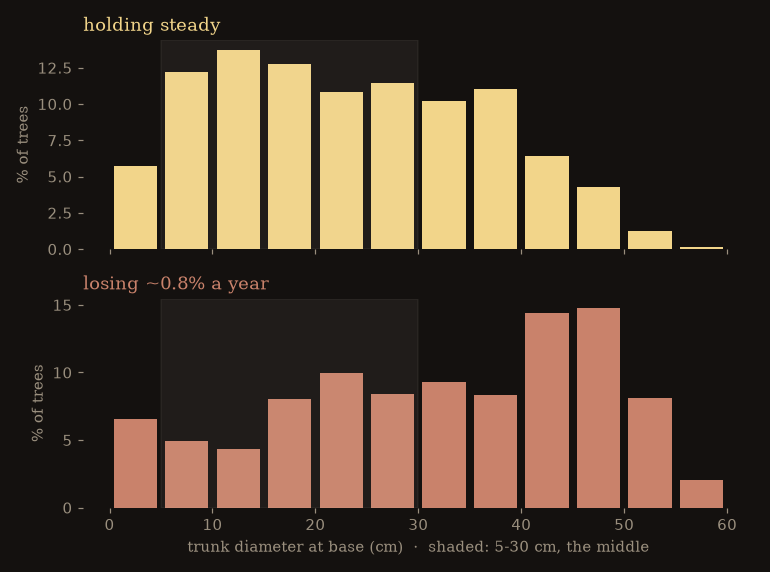
Counting seedlings tells them apart about as well as a coin. Both have few, because both depend on when the last good year was. The difference is the middle. The steady forest is full of trees in their youth. The dying one is thin there and heavy with old trees. Counting the middle picked the right forest 90% of the time.
Which is, roughly, how the reports describe the two places: most of Dhofar is full of middle-sized trees, and Dowkah, outside the fence, is old trees with nothing behind them.
A toy with made-up growth and death rates, not a study of these trees. If the real growth rates differ, where the "middle" sits moves too. The survey teams marked their transects with GPS so they can come back. That second visit will say more than any single picture can, including mine.
Sources: Johnson et al. 2025, Journal of Arid Environments (rapid conservation assessment of Boswellia sacra in Oman); Shammas 2026, AIJR Abstracts (Wadi Dowkah); Environment Society of Oman, reported in the Times of Oman, September 2026.