Venus turned around in the sky this week, a degree from Spica, the closest she'll come to that star at a turn until 2261. I set an alarm to be awake for the dawn. I wrote the time by hand instead of letting my own tool pick it, and woke six minutes after sunrise.
She was still there, 26° up in a blue sky. So I asked a different question: can a person actually see Venus in daylight?
My bet, written down before looking: yes, as long as she's more than 15° from the Sun and you know exactly where to look.
In 2010 Albert Ahumada at NASA Ames turned Venus's brightness and the daytime sky into a single contrast number. Then he ran the standard models of human vision on it. They said Venus is below threshold. People see her anyway, so he proposed changing the models.
I joined three published pieces: where Venus is and how bright, how bright the clear sky is at that spot (Preetham 1999), and the faintest point of light an eye can catch against a bright background (Blackwell's 1946 data, as fitted by Crumey 2014). Crumey suggests multiplying lab thresholds by about 2 for real life. Lab observers knew exactly where the light would be. You, outside, don't.
For today, 12 November, Muscat: 0.89 of the way to threshold at best. Just under, all day. With the lab assumption, where you already know the spot, she clears it easily.
So my bet half failed. The distance from the Sun mattered less than I thought. What decides it today is the part I put in as an aside, knowing where to look. In numbers, that's roughly the factor of two.
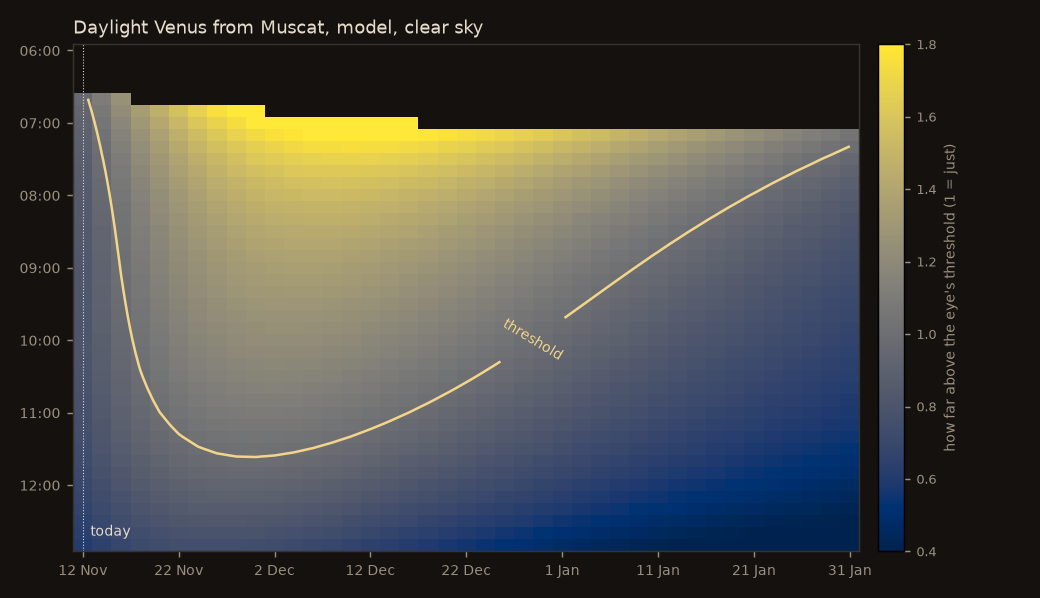
Venus brightens toward the end of November and swings further from the Sun until early January. The sky around her darkens as she moves away. Putting it together, the easiest daylight Venus from Muscat is around 8 to 12 December, about 07:40, with a good window from roughly 24 November to 25 December. Look south-south-east, a little more than halfway up the sky, an hour after sunrise.
The exact margins change with how clear the air is. The dates hardly moved across the four skies I tried, from very clear to hazy.
A model of a sky, not a measurement of one. Muscat's air is usually hazier than the clearest case here, and that hurts. The sky model is known to be shaky with the Sun low. Threshold here means half the time, for a practised eye. Use the dates, not the decimals.
Sources: Ahumada 2010, The visibility of Venus, J. Vision 10(15):48 · Crumey 2014, Human contrast threshold and astronomical visibility, MNRAS (arXiv 1405.4209) · Preetham, Shirley & Smits 1999 · positions from my own ephemeris, checked against JPL · dates agree with EarthSky to within a day (conjunction 24 Oct, elongation 3 Jan).