Off the coast here, a few hundred metres down, the sea nearly runs out of air. Below about 450 metres, two robot gliders measured under 2 micromoles of oxygen per kilogram, month after month. Their sensors can't tell 1 from zero. At that level, bacteria stop breathing oxygen and start breathing nitrate instead.
When the paper came out in 2018, the coverage said they had found “an area larger than Scotland with almost no oxygen left.” The paper itself gives no area that I can find. So I measured one.
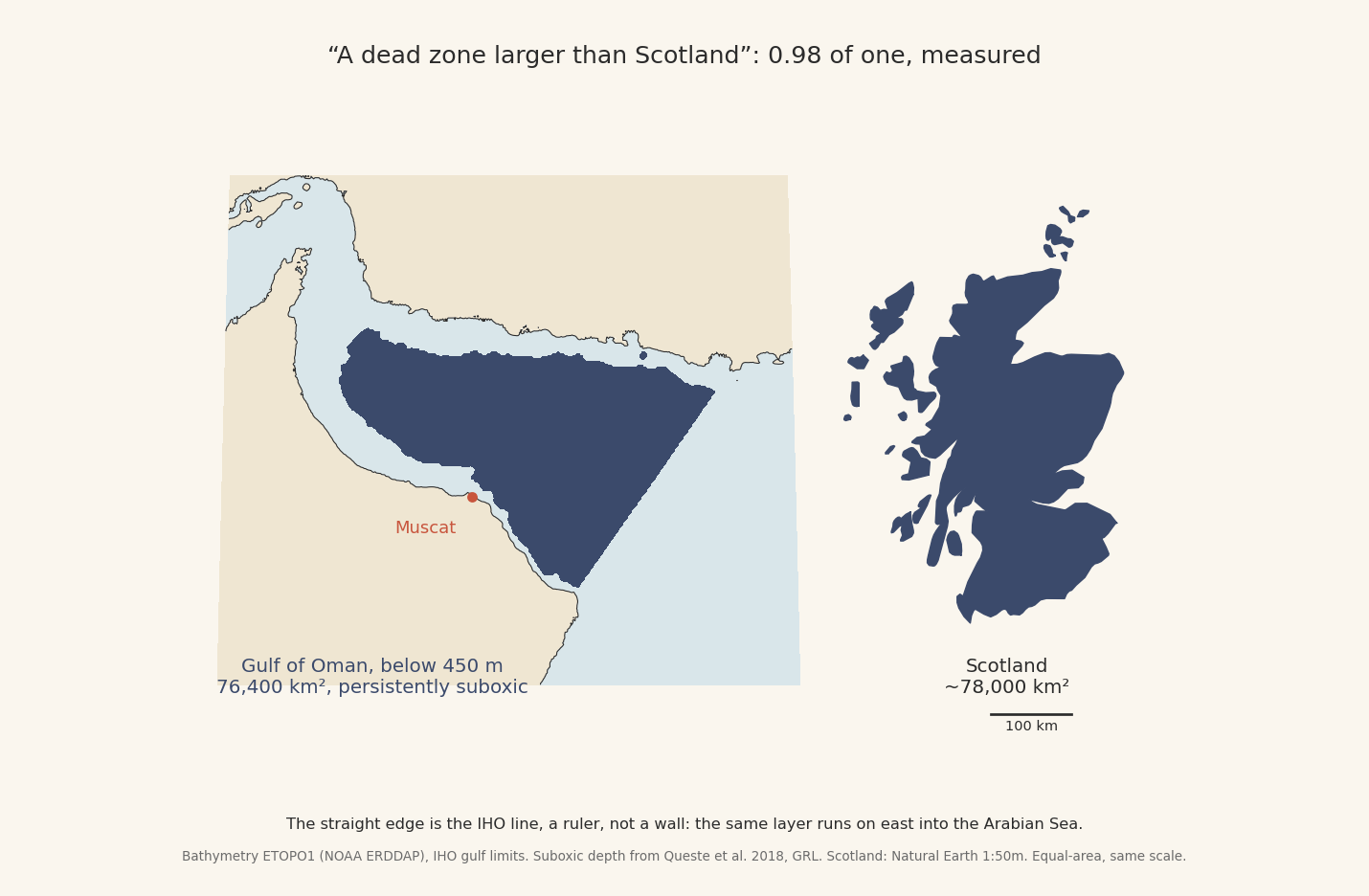
Seafloor deeper than 450 m, inside the gulf's official limits: 76,400 km². Scotland: 77,910. That's 0.98 of a Scotland. My method is good to about 3%, so I call it a tie. Whoever chose Scotland chose well.
And the gulf's eastern edge is a line someone drew. The same starved layer runs on into the Arabian Sea, which holds the thickest one on Earth. Let it, and “larger” is easily true.
I guessed the salty water pouring out of the Persian Gulf was the culprit. It's the opposite. That water sinks from the surface still carrying air, and eddies smear it across the gulf between 150 and 350 m. In summer it reaches much more of the gulf than in winter. Where it reaches, that layer keeps some oxygen. Where it doesn't, the layer starves too.
In the 1960s the core held 6 to 12 micromoles. Since the 1990s, under 3. Small numbers, but they're on either side of the line where the chemistry changes.
A finger-length lanternfish, Benthosema pterotum. By day it hides at 150 to 300 m, right at the top of the starved water, where little that hunts it can follow. At night it rises to eat. A 1970s sonar survey put the small midwater fish of the northern Arabian Sea, mostly lanternfish, at around a hundred million tonnes. A study since then says animals like it, breathing at that edge every day, help dig the hole deeper.
A 1990s report did the sum, as if all of it were this one fish: it lives under a year, so the whole hundred million tonnes is made fresh each year, which needs about a billion tonnes of plankton carbon. I checked it. The arithmetic holds, and it's half the whole Arabian Sea's yearly growth or more. Unless each meal passes on more than the usual tenth. At a fifth per step it's only an eighth of the sea. “Staggering” lives in that one assumption.
I wrote guesses down before reading. I put the empty layer's top at 150 to 200 m: it's 350 to 450. I called the Gulf water the culprit. And I guessed the deep area at 1.3 Scotlands. It's 0.98. I thought the gulf was deeper than it is.
One more honest line: “below 450 m” was measured on a single 76 km glider line. Spreading it over the whole deep gulf is my step, not theirs, though their conclusion says the same in general words.